Featured Post

Letterboxd Reviews

So as you know, I stopped writing lengthy reviews on this site this year, keeping the blog as more of a film diary of sorts.  Lo and behold,...

Showing posts with label tom hanks. Show all posts

Tuesday, October 04, 2022

Elvis

 Elvis (2022)
Starring Austin Butler, Tom Hanks, Olivia DeJonge, Helen Thomson, Richard Roxburgh, and Kodi Smit-McPhee
Directed by Baz Luhrmann
Written by Baz Luhrmann, Sam Bromell, Craig Pearce, and Jeremy Doner


The RyMickey Rating:  B

Tuesday, September 14, 2021

You've Got Mail

 You've Got Mail (1997)
Starring Tom Hanks, Meg Ryan, Parker Posey, Greg Kinnear, Jean Stapleton, Dave Chappelle, Steve Zahn, Heather Burns, and Dabney Coleman
Directed by Nora Ephron
Written by Nora Ephron and Delia Ephron


The RyMickey Rating: B-

Sunday, September 05, 2021

Turner & Hooch

 Turner & Hooch (1989)
Starring Tom Hanks, Mare Winningham, Craig T. Nelson, and Beasley the Dog
Directed by Roger Spottiswoode
Written by Dennis Shryack, Michael Blodgett, Daniel Petrie, Jr., Jim Cash, and Jack Epps, Jr.


The RyMickey Rating: D+

Monday, June 29, 2020

Splash

Splash (1984)
Starring Tom Hanks, Daryl Hannah, John Candy, and Eugene Levy
Directed by Ron Howard
Written by Lowell Ganz, Babaloo Mandel, and Bruce Jay Friedman

The RyMickey Rating: C+

Saturday, May 30, 2020

A Beautiful Day in the Neighborhood

A Beautiful Day in the Neighborhood (2019)
Starring Matthew Rhys, Tom Hanks, Susan Kelechi Watson, Chris Cooper, Maryann Plunkett, Enrico Colantoni, Wendy Makkenna, Tammy Blanchard, and Christine Lahti
Directed by Marielle Heller
Written by Micah Fitzerman-Blue and Noah Harpster


The RyMickey Rating: A-

Monday, May 27, 2019

The Circle

The Circle (2017)
Starring Emma Watson, Tom Hanks, John Boyega, Karen Gillan, Ellar Coltrane, Patton Oswalt, Glenne Headley, and Bill Paxton
Directed by James Ponsoldt
Written by James Ponsoldt and Dave Eggers


The RyMickey Rating:  C-

Wednesday, February 28, 2018

The Post

The Post (2017)
Starring Meryl Streep, Tom Hanks, Sarah Paulson, Bob Odenkirk, Tracy Letts, Bradley Whitford, Carrie Coon, Jesse Plemons, Matthew Rhys, and Bruce Greenwood
Directed by Steven Spielberg
Written by Liz Hannah and Josh Singer

Summary (in 500 words or less): Washington Post owner Katherine Graham (Meryl Streep) -- the first female owner of a major newspaper -- and editor-in-chief Ben Bradlee (Tom Hanks) are struggling to keep their paper afloat in the early 1970s.  The New York Times -- one of their major competitors -- breaks a huge story about multiple presidential administrations hiding information about the Vietnam War from the American public.  This classified info was admittedly stolen from the US government and the Nixon administration sues them to stop the release of any more info. Fortunately for the Washington Post, a secret informant drops that same information off to them and Graham and Bradlee are faced with the challenge of whether to publish the information or not.


  • A true story, Spielberg's The Post feels a bit languid, slow, and plodding.  
  • A good performance from Meryl Streep -- seriously, I keep wanting to not like her in things, but I can't -- balances out a less successful turn from Tom Hanks who, despite having some backstory given to his character, never really connected with me.
  • Much like Hanks not connecting with me, the film itself didn't either.  Spielberg's direction felt a bit stiff and stolid, and while I liked the way the film looked and some camera angles here and there, it's just bland and unexciting.
  • The script by Liz Hannah and John Singer thinks it cleverly is inserting subtle jabs at the current administration and praise of the #MeToo movement, but they're so blatantly displayed by Spielberg that it often proves to be laughable.  Particularly towards the end, the feminism angle is ridiculously displayed -- Streep's Graham leaves a Supreme Court hearing to find herself surrounded by cheering throngs of women as the music swells around her.  Ridiculous.  The film didn't need that -- we already saw what a strong and committed woman Graham was...we didn't need the silly visual.
  • This may be a film that generationally simply doesn't work.  Perhaps the older crowd -- re: those around in the Vietnam War era -- may feel more connection and excitement with the unfolding story.  To me, however, I was left disappointed.
The RyMickey Rating:  C


Friday, September 15, 2017

Movie Review - A Hologram for the King

A Hologram for the King (2016)
Starring Tom Hanks, Alexander Black, Sarita Choudhary, Sidse Babett Knudson, and Ben Whishaw
Directed by Tom Tykwer
***This film is currently streaming via Amazon Prime***

When businessman Alan Clay (Tom Hanks) travels to Saudi Arabia to hawk his company's holographic telecommunication system to the country's king and government, he's leaving very little behind in the States.  Divorced with a college-aged daughter who wants little to do with him, Alan throws everything into this presentation, but Saudi Arabia isn't exactly the most modernized locale as Alan discovers when his team faces a lack of wifi and sandy floors in their tent located in the desert supplied by the Saudi Arabian king.  The pressure to deliver causes Alan to begin to lose it a bit, coming face-to-face with a late mid-life crisis that unfortunately for him occurs in a foreign country quite different from the one he knows.

A Hologram for the King is well-acted by Hanks and the rest of the cast, but after about forty-five minutes, the film's lack of a decent plot does it in.  Some weird dream-like sequences that begin to populate the film as it progresses set up some weird tonal shifts...and that's followed by a third act that feels full of some unnecessary side plots that purportedly try and resolve Alan's emotional crises, but end up seeming oddly out-of-place.  In the end, the amiable Hanks can't save the "kitchen sink"-type plot and direction that fail to set up a consistent mood.

The RyMickey Rating:  C-

Thursday, October 13, 2016

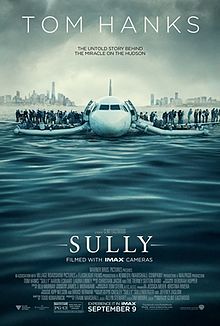
Movie Review - Sully

Sully (2015)
Starring Tom Hanks, Aaron Eckhart, Mike O'Malley, Jamey Sheridan, Anna Gunn, and Laura Linney
Directed by Clint Eastwood

I have long criticized that as a director Clint Eastwood doesn't create films that garner an emotional connection between the characters and the audience.  There's a disconnect that Eastwood often isn't able to overcome even in films where the kinship should be palpable (ex: American Sniper).  I'm happy to report that isn't the case in Sully, a film that retells the tale of pilot Chesley "Sully" Sullenberger and his successful attempt to land a passenger aircraft on the bitterly cold Hudson River on January 15, 2009, after a massive engine failure.  Credit is certainly due to Eastwood for crafting a briskly edited film and capturing a fantastic performance from Tom Hanks as the title character.

The film places Sully in a bit of a predicament, opening not by showing the audience the Hudson River landing, but instead in the midst of the build-up to an evidentiary hearing debating whether Captain Sullenberger could've landed his plane at one of several nearby airports as opposed to on the water.  Most of the film is spent doubting Sully's abilities (by both the NTSB and Sully himself) while at the same time the media touts his heroic effort, and this juxtaposition causes the title character to question his actions -- is he really as good of a pilot as he thought he was and does he deserve the praise he's receiving nationwide despite the fact that he saved all 155 souls onboard the plane.  This conceit of placing Sully under fire does wonders for creating a well-rounded title character in that it allows the fantastic Tom Hanks to play someone largely doubting himself throughout the entirety of the film, a man haunted by a frightening event that, for all intents and purposes, ended positively.  Rather than just be portrayed as a outright hero, Hanks is allowed to layer his performance with humility, anger, confidence, weakness, and strength.  Tom Hanks has always been known as the modern-day Jimmy Stewart -- cinema's everyman, cinema's "normal guy."  While there may seem to be a simplicity with playing a regular joe character like Sully, Hanks creates an effortlessly humbling performance which, to this moviegoer, isn't necessarily easy to achieve.

Kudos must also be given to Eastwood whose tautly directed film (which clocks in at a speedy 96 minutes) creates suspense out of a 205-second plane landing and its aftermath -- the results of which we in the audience already know the outcome.  In a successful effort to keep our interest, Eastwood (and the screenwriter, presumably) has his film jump around in time and while we in the audience never question where we are in the chronological timeline, we at least are given a bit of a puzzle to piece together from this admittedly well-known story.  While it gets a tad repetitive towards the end (we essentially get a complete redo of the plane landing sequence which we had already seen less than thirty minutes prior), Eastwood successfully creates a tension-filled movie and doesn't disappoint with his lensing of the initial landing sequence -- a moment we in the audience are waiting for from the outset.

Along with a nice supporting turn from Aaron Eckhart as Sully's co-pilot Jeff Skiles (who is a real-life person I didn't know about in the slightest), Eastwood has created a winner with Sully.  Color me surprised as I didn't think the aging director had it in him, but he proved me wrong with this one.

The RyMickey Rating:  B+

Friday, November 27, 2015

Movie Review - Bridge of Spies

Bridge of Spies (2015)
Starring Tom Hanks, Mark Rylance, Amy Ryan, Alan Alda, Austin Stowell, Will Rogers, and Jesse Plemons 
Directed by Steven Spielberg

Bridge of Spies is two movies for the price of one -- unfortunately, only one of those movies is really compelling.  Despite decent direction from Steven Spielberg (that isn't without its faults) and a nice performance from Tom Hanks, Bridge of Spies works for its first half, but falters a bit during its second half with a story that becomes a bit repetitive and proves to be not quite as intriguing as it thinks it is.

Based on a true story, Hanks is James B. Donovan, an insurance lawyer, who is asked by the US government to defend Rudolf Abel (Mark Rylance), a man accused of being a KGB spy.  Despite the disapproval of Donovan's own firm, judges, and the public, Donovan believes that he owes Abel the best defense possible.  In the film's successful first half, we see the intricacies of law as Donovan tries to maneuver his way around all the barriers to a fair trial set up against him.  The film falters a bit as it proceeds, however, when Donovan is then chosen by the government to head to a newly formed and very volatile East Germany in order to negotiate with both the Germans and the Russians to formulate a trade to bring back both a young US Air Force pilot (Austin Stowell) being held as a spy whose plane crashed in the USSR and a young US graduate student (Will Rogers) captured by the Germans who fear the kid was attempting to harm their communist agenda.  While these aspects seem compelling in print, the film doesn't do the best job at integrating the two "Prisoner of War" stories into the overall plot and, quite frankly, the negotiations simply aren't as interesting to watch as Donovan's struggles with the US judicial system.  While I recognize the appeal of including both halves of the story -- and they do connect with one another in an absolutely logical way -- the halves just aren't equal to one another in terms of quality of plot and the fact that the better half is first ends the movie on more of a down note.

Granted, that isn't to say that the second half is unwatchable, but it does come as a disappointment because the first half is surprisingly compelling thanks in large part to Tom Hanks' performance as Donovan.  Hanks has had a bit of a career renaissance as of late and it's good to see him back in top form.  While I don't think the role of Donovan was a particularly tricky one to play, it proves that Hanks is still the go-to guy to play the "everyman" -- we're fully taken in by his struggles and are right there with him as he fights to do his job to the best of his ability and protect his family from the slings and arrows being thrown his way by the American public who aren't fans of his defending a purported spy.  Mark Rylance is also good as spy Rudolf Abel, but the Oscar buzz surrounding him is a bit confounding to me.  While he plays Abel as a completely different spy than we're used to seeing -- which was unique and admittedly refreshing -- I never felt as though his character had much of an arc to go through and because of this there wasn't a lot that he could really dig his teeth into story wise.

Bridge of Spies is certainly solid, but it's really just a mid-level Spielberg flick.  The director nicely balances a surprisingly light-hearted tone throughout the piece (likely thanks in part to a script co-written by the Coen Brothers), but he too often tosses in some obvious symbolic references that are eye-rolling as opposed to powerful -- as an example, as some Germans attempt to cross the Berlin Wall, they are shot; thirty minutes later in the film, Spielberg shows American kids freely climbing over a fence between houses in New York.  Cue the groan-inducing eye roll or the obviousness of that visual allegory.  Still, overall the film works, is worth seeing, and depicts an interesting true story from our past.

The RyMickey Rating:  B-

Saturday, January 18, 2014

Movie Review - Saving Mr. Banks

Saving Mr. Banks (2013)
Starring Emma Thompson, Tom Hanks, Annie Rose Buckley, Colin Farrell, Ruth Wilson, Paul Giamatti, Bradley Whitford, B.J. Novak, Jason Schwartzman, Kathy Baker, Melanie Paxson, and Rachel Griffiths
Directed by John Lee Hancock

Poor Saving Mr. Banks.  Hit with articles and speeches (thanks, Meryl Streep) saying that it's a whitewash of Walt Disney's "true" misogynistic and anti-Semitic leanings, intent on being a love letter for the cherished movie company, the family friendly film all but missed the boat on Oscar nomination day failing to earn a nod beyond Best Score.  Critics of the film will tell you that the movie sets up Mary Poppins author P.L. Travers as a put-upon lady who had to succumb to "Uncle Walt's" wishes in order to finally have a film version of her classic novel placed up on the screen.  Quite honestly, I can't help but think that's a bunch of baloney as that's not at all what I saw in this movie.  Travers' headstrong personality may have kowtowed in certain areas of production, but to call her an obsequious woman trampled on by a larger than life figure misses the boat completely.  Yes, Saving Mr. Banks is a film about letting things go, but Travers isn't "giving up" her beloved Mary Poppins.  Instead, she's giving up some long-standing guilt that's she's clung to since her childhood.  The story here isn't really about the making of a movie...it's about one woman's acceptance of the past and willingness to forgive herself for things beyond her control.

Saving Mr. Banks manages to take two separate storylines and weave them together rather seamlessly thanks to a lovely script by Kelly Marcel and Sue Smith and nice (though perhaps a tiny touch heavyhanded) direction by John Lee Hancock.  First, we see an adult Pamela Travers (Emma Thompson) finding herself facing monetary trouble.  With her unwillingness to write any more novels and sales of her Mary Poppins series dwindling, London-based Travers is convinced by her agent/publisher to travel to California and meet with Walt Disney (Tom Hanks) to discuss the making of Poppins into a feature film.  Upon her initial meeting with the Hollywood mogul, Travers agrees to see what Disney, screenwriter Don DeGradi (Bradley Whitford), and songwriters Robert and Richard Sherman (B.J. Novak and Jason Schwartzman) have crafted for her beloved nanny character.  Travers is not an easy woman to please.  While some may call her curmudgeonly, she simply has a vision as to what she believes Mary Poppins should be.

The reason for that vision is because, as much as she tried to suppress it for decades, Mary Poppins is really a re-imagined telling of what she longed for her childhood to be.  In the other half of Saving Mr. Banks, we bear witness to Travers' youth.  Young Ginty (Annie Rose Buckley) simply adores her father Travers Goff (Colin Farrell), a banker whose imaginative mind created a fantastical world for Ginty and her two siblings despite the family living on a dilapidated ranch in Australia.  Travers wanted nothing more than to provide for his family, however, he was dealing with his own personal demons in the form of alcohol and young Ginty carried around the guilt for decades of not being able to "save" her father from placing his lips to the bottle.

As we discover, Ginty is really Pamela Travers with Pamela changing her name in adulthood to honor her father.  The film bounces back and forth between the two storylines with each allowing the other to become richer and more well-rounded as layers are revealed.  We begin to realize that it's her childhood experiences that shaped Pamela Travers into the no-nonsense (perhaps even crotchety) woman that she became.  She used her novel to try and cope with the demons of her past, but rather than helping her let them go, the book made them cling to them even more.  Through the making of the film version of Mary Poppins, Travers is able to release them (even if just a little bit), but this doesn't come without an emotional toll for her.

Emma Thompson is fantastic as P.L. Travers.  Admittedly, she starts off rather one note, with Travers being a woman of clipped, precise words, showing little to no emotion behind a rock-hard exterior.  However, as the film progresses, we see glimpses of her ice queen nature being melted away.  It's this change that has many of the film's critics crying fowl with the critique being that through the "magic of Disney," all of her problems were solved.  That's just not the case.  Thompson's Travers can really be summed up in the film's final scene (of which, I guess, this could be considered a spoiler, so read on with that knowledge) in which Travers sits watching the Hollywood premiere of Mary Poppins.  Without a single word and only through facial expressions and the slightest of body movement, we see Travers initially disgraced with her selling out of her beloved character, angered by the addition of animation (which she was adamantly against), yet moved by the lovely depiction of family life and of a father who wanted nothing more than his children to flourish and grow beyond what he could provide for them.  John Lee Hancock stays focused on Thompson's face and it's a fantastic moment that carries so much more emotional impact than what we're seeing on the surface because of everything Thompson brings to the role.

Although Thompson is certainly the center of the film, she's surrounded by fantastic performances all around, including Tom Hanks as the equally opinionated Walt Disney.  Disney here is a nice guy who's willing to make concessions to Travers, but not willing to forgo his knowledge of what makes "quality" movies.  The back-and-forth between the two actors is oftentimes brilliant and was a treat to watch.  A very nice and subdued supporting turn from Paul Giamatti as Travers' driver was also a nice addition.  Really, though, there's not a bad performance here at all and that's certainly something worth recognizing.

I will admit that I come to Saving Mr. Banks with some inherent bias in that I'm the biggest Disney fan I know.  However, I also approached this film with a great level of fear and trepidation that it wouldn't even come close to living up to the bar I had set for it.  In fact, I avoided watching the film for nearly a month because I simply didn't want to have my hopes shattered.  I'm beyond pleased to state that my worries were unfounded.  Saving Mr. Banks is an absolutely lovely film that carries much more emotional depth than I ever could have expected.

As a side note, stay halfway through the credits.  There, you'll hear taped recordings of Travers duking it out with the Sherman brothers and screenwriter Don DeGradi over the script.  It shows that the film's depiction of Travers was certainly true-to-form.


The RyMickey Rating:  A-

Friday, November 22, 2013

Movie Review - Captain Phillips

Captain Phillips (2013)
Starring Tom Hanks, Barkhad Abdi, and Catherine Keener
Directed by Paul Greengrass

The true-life plot of Captain Phillips is incredibly simple.  Our title character -- Richard Phillips -- is captain of the Maersk Alabama cargo ship traveling along the east coast of Africa past the country of Somalia to the west.  Notorious for being an area heavily frequented by pirates, Phillips (played by Tom Hanks) and his crew cautiously make their way past Somali waters, only to find themselves being attacked by a small pirate boat with a crew of four headed by a young Somali man named Muse (Barkhad Abdi).  The setting eventually changes to a much smaller lifeboat, but, ultimately, the same overall perspective doesn't really change as we're still dealing with the concept of an innocent man fighting for his survival.

Somehow, though, despite the lack of a truly complicated story, Captain Phillips overstays its welcome by quite a bit.  I realize we're dealing with a true story here, but director Paul Greengrass doesn't quite succeed at keeping the tension ratcheted up at all times.  When we're dealing with the more massive scope of the bigger cargo ship, the ever-moving camera of Greengrass fits quite nicely adding to the constant tension felt by Phillips and his crew.  However, about halfway through when the scene shifts to the smaller lifeboat inhabited by Phillips and his four captors, I couldn't help but think Greengrass wasn't able to adapt and this portion of the film fell rather flat for me, seemingly dragging for much longer than he intended.  I find this rather odd as Greengrass has proven he can work under more constrained conditions as his United 93 takes place inside the cramped confines of an airplane and holds a place in my Personal Canon.  Something didn't click here, though.

What Greengrass does successfully accomplish is to pull a very nice performance out of Tom Hanks.  When the film begins, Phillips is just a normal guy talking with his wife (Catherine Keener in what essentially amounts to a cameo appearance) about their kids as he drives to the airport.  When he arrives on the Maersk Alabama, his only perspective is moving the cargo from Point A to Point B.  However, as soon as the threat of pirates becomes imminent, we see Hanks' Phillips flick a switch and become a quiet hero -- someone who puts himself in the line of fire before his men, doing whatever he can to keep his people safe, while, at the same time, creatively "scheming" to make sure he's always one step ahead of his captors.  We can sometimes see Phillips' inner mind working, planning out his strategy, and I found it interesting to watch.  By the film's end, Phillips has a moment for his bottled up emotions to come steaming out and the scene solidifies the performance as being one of Hanks' best of the past decade.

In the end, however, Captain Phillips is a film that should've been tense and riveting throughout, but it really isn't all that successful in achieving that goal in its second half.  The flick works for the first hour -- the scene of the pirates invading the cargo ship is stellar -- and its final scene is riveting, but overall, this one proved to be a disappointment for me.

The RyMickey Rating:  C+

Friday, July 05, 2013

Movie Review - Cloud Atlas

Cloud Atlas (2012)
Starring Tom Hanks, Halle Berry, Jim Broadbent, Hugo Weaving, Jim Sturgess, Ben Whishaw, Susan Sarandon, Hugh Grant, Doona Bae, and Keith David
Directed by Tom Tykwer, Andy Wachowski, and Lana Wachowski


"Our lives are not our own.  From womb to tomb we are bound to others past and present.  And by each crime and every kindness, we birth our future."

The epic, nearly three hour Cloud Atlas can be summed up in the quote above that comes at the film's end.  As actress Doona Bae said the words, it was immediately obvious that she was spouting the film's thesis as set forth by its trio of writer-directors Tom Tykwer, Andy Wachowski, and Lana Wachowski.  And after that line is said, I found myself asking this question: Is it possible to really like a movie even if you feel like its deep underlying meaning isn't fully realized despite the fact that its screenplay tries to hammer it home over and over again?  The answer I've realized is yes because Cloud Atlas is a film that may not be perfect, but is wholly original, visually appealing, and surprisingly compelling throughout its lengthy run time.

Essentially six separate stories, the overarching point of Cloud Atlas is to tell us that all of our current actions affect those that come after us which is why the stories here -- spanning the centuries from 1849 to 2321 -- are somewhat connected to one another, some by tenuous strands and some by significant plot points.  With each story undertaking a different genre -- there's comedy, suspense, romance, sci fi, historical drama -- it's as if we're watching a bunch of separate movies that are held together by both the film's theme and the interesting, entirely successful gimmick of having the members of the cast play different roles in all of the storylines.  So, as an example, while Halle Berry is the lead in the suspense segment, her role as a different character in the romance tale is a minimal one.  The same goes for Tom Hanks, Ben Whishaw, Jim Broadbent, Jim Sturgess, Hugo Weaving, Susan Sarandon, and Hugh Grant, all of whom make up a very nice ensemble and get the chance to play a variety of roles.

The film looks expensive and for a movie spanning so many genres and centuries, it's good that things don't look as if they were done on the cheap.  From the special effects to the scenic design to the nice score, all of the technical aspects of Cloud Atlas deserve praise.  Directors Tom Tykwer and the Wachowski siblings have really crafted something that I found rather intriguing on the visual side of things.

Overall, what prevents the film from thoroughly reaching its ambitious intentions is the fact that some of the stories just don't carry the gravitas of, as one character put it, showing "the consequences of one's life rippling through eternity."  As an example, I loved the comedy segment of the film featuring Jim Broadbent as a book editor who, after running afoul with one of his clients, is forced to go on the run and finds himself locked up in an old person's home.  I thought the story was well thought out, humorous, and completely entertaining.  However, I don't quite understand how it fit in with the six other stories.  Yes, there is a brief mention of Broadbent's character in the sci fi segment, but for the heftiness of the overarching theme, it doesn't quite work.  Granted, I understand that many people on this planet will only affect others in small ways, but I'm not quite sure for the scope and grandeur of Cloud Atlas that we should've been focusing on these people in this movie.

Still, while that may seem like a somewhat large "problem," it really isn't.  While it knocks the film down from a perfect level, Cloud Atlas is still a fascinating film that I'm still thinking about days after watching it.  Moreso than many of 2012's films, this is one that I look forward to watching again a few years in the future.

The RyMickey Rating:  B+

Friday, February 17, 2012

Movie Review - Extremely Loud and Incredibly Close

Extremely Loud and Incredibly Close (2011)
Starring Thomas Horn, Sandra Bullock, Viola Davis, Max von Sydow, John Goodman, Jeffrey Wright, and Tom Hanks
Directed by Stephen Daldry

The last Best Picture nominee I needed to watch, I was dreading seeing Extremely Loud and Incredibly Close as it seems to be the most reviled of the nine films up for the top prize.  I had read the book and enjoyed it, but the reviews calling Stephen Daldry's flick emotionally manipulative and heavy-handed made me wait until the very last minute to see this.  Well, in the end, I can't help but feel that I've certainly saved one of the best flicks of 2011 for last because Extremely Loud and Incredibly Close is powerful, heartbreaking, and inspiring -- a lovely film that has been unfairly maligned throughout this awards season.

Oskar Schell (newcomer Thomas Horn), an eleven year-old kid with symptoms of Asperger Syndrome (despite having an inconclusive diagnosis for the disorder), was having a perfectly normal day on September 11, 2001 -- but that was the day his life was personally changed forever.  His father (Tom Hanks), a jewelry store owner, had a meeting in the World Trade Center that morning and like thousands of others, he did not make it out alive.  Finding it incredibly difficult to cope with the loss, Oskar comes across a small manilla envelope holding a key in his father's closet.  On the envelope is written the word "Black" and, as a way to keep his father's presence alive in his mind, Oskar sets out on a mission across all of New York City to meet every single person with the last name of "Black" to find out if they know what the key will open in hopes that it will somehow tell him more about his father.

Perhaps the film could be labeled sappy, but I found it incredibly moving and touching.  Yes, it could be deemed heavy handed, but we're dealing with subject matter here that is incredibly intense and the film doesn't tiptoe around it.  In what is perhaps the best film I've seen that deals with the 9/11 tragedies (that isn't a "documentary-type" film a la the spectacular United 93), I'm not ashamed to admit that my eyes welled up multiple times here.  Yes, I know no one that was harmed on 9/11, but this film speaks to anyone who has experienced any type of loss, grief, and pain, and speaks to the courage and drive necessary to move on and continue living your life to its full potential.

A film which places a young fourteen year-old kid who has never acted before front and center in every single scene of the movie is asking for trouble if the kid doesn't connect with the audience.  That certainly isn't the case here -- I found Thomas Horn a revelation.  I realize that's not a word to throw around lightly, but I was really moved by this kid in an incredibly difficult role.  I wrote in my original review of the novel that I was so irritated by the character of Oskar that I almost put down the book 100 pages in.  The cinematic Oskar worked much better for me.  Perhaps I was simply prepared for the quirkiness of the character -- his carrying around of a tambourine to calm himself is just one of his eccentricities -- or perhaps Horn just embodied the character in such a way that made his idiosyncrasies more believable to me.  Regardless, despite having a completely different personality than me, I somehow felt incredibly connected to this young kid -- Horn is really playing an "everyman" trying to cope with grief and that portrayal deeply moved me.

Horn isn't alone in excelling in the acting department.  Hanks is rather charming in his small role as Oskar's father.  In his limited screen time, it's obvious why Oskar loved his father as much as he did and it was his father's joie de vivre that sends Oskar on his mission.  Similarly, Sandra Bullock is surprisingly powerful in her limited role as Oskar's mother.  Her scenes with the young Horn are gripping and oftentimes heartbreaking.

However, it's Horn's scenes with Max von Sydow that I'll remember the most.  Von Sydow plays a man simply known as The Renter, an elderly gentleman who has moved in with Max's grandmother who lives in an apartment across the street from his home.  The Renter doesn't speak and instead writes all his thoughts in a little notebook, but Oskar finds himself able to communicate with The Renter more than anyone else in his life.  With nary a word spoken, von Sydow is wonderful and positively moving, able to express everything we need to know with the raise of an eyebrow or a shrug of the shoulders.

[There is also a beautiful scene that occurs near the film's conclusion with a man played by Jeffrey Wright whom Oskar meets on his quest to discover the purpose of the key that nearly gave me chills. (Too much discussion of this scene would be a bit of a spoiler so I'll stop here, but I'll likely be discussing it more in my Best Scenes of the Year category in the RyMickey Awards.)]

What is a movie if it's not "manipulative."  Film is one of the most "manipulative" art genres around.  All movies have an agenda/story to tell and they all try to take their audience on whatever journey the director and screenwriter want us to see.  To toss the claim around that director Stephen Daldry and screenwriter Eric Roth are simply playing on our emotional connection to 9/11 isn't a fair critique.  They take a horribly tragic moment in our American history, narrow it down to a specific person's take on that painful day, but somehow manage to make it contain themes that speak to us all.  Kudos all around on this one.  Extremely Loud and Incredibly Close is, by far, one of the best films of 2011.

The RyMickey Rating:  A

Monday, April 04, 2011

Movie Review - Radio Flyer

Radio Flyer (1992)
Starring Elijah Wood, Joseph Mazzello, Adam Baldwin, Lorraine Bracco, and Tom Hanks
Directed by Richard Donner (and an uncredited David Evans)
***This film is streaming on Netflix***

***Posted as part of the Elijah Wood Early 90s Mini Film Festival***

Radio Flyer simply isn't a very good film.  [That will probably be a line you'll see a lot in this Elijah Wood Retrospective.]  However, it's got two of probably the most natural kid performances captured on camera from Elijah Wood and Joseph Mazzello that I can't help but like it more than I should.  Wood (who was probably 10 or 11 at the time of filming) and Mazzello (who was probably 8) are really charming and there's an absolute sense that neither of them are really acting in several scenes -- they're simply being themselves.  That naturalness and ease in front of the cameras is winning, but, in the end, the silliness of the story can't match the acting chops.

Admittedly, I think this was one of the first films that I went to when I was younger and got emotionally invested in.  As a 12 year-old kid who had younger brothers, this thing resonated with me.  The story about an abusive father couldn't have been farther from my real life, but what did connect was this idea of having to be protective of your siblings.  In Radio Flyer, older brother Mike (Wood) tries to do whatever he can to protect his younger brother Bobby (Mazzello) from the near constant beatings of his stepfather, a man seen mostly in shadows and known only as The King (Adam Baldwin).  The two brothers make a promise to one another to not tell their mother (Lorraine Bracco) about the beatings because she seems to be happy for once in her life with The King and she's always led a rather sad existence.  In order to avoid The King, Mike and Bobby spend most of their time exploring the area around their new home during which they hear about the tale of Fisher, a kid who many years ago crafted a flying machine out of his bicycle in an attempt to become airborne.  This gives Bobby an ingenious idea to utilize their Radio Flyer red wagon as a means to fly away from the pain in his life.

Sentimental, mushy, and kind of silly, Radio Flyer simply doesn't succeed in its storytelling.  It apparently was heavily re-written, re-shot, and changed directors' hands...and it shows.  There's not really any cohesion throughout and it takes a long time to figure out where it wants to go...and when it gets there, it still doesn't work.

However, as I said above, there's two pretty great kid performances here and, to a certain extent, that's a reason to watch despite the lower rating I'm going to give this below.  Seeing as how this would've been my first Elijah Wood movie, I can see why I liked him as an actor.  Here is this kid in a movie with Tom Hanks (who has a small cameo as a grown-up Mike).  Even at 12 years old, I knew Hanks was a "movie star" and Wood is holding his own up against this Hollywood bigwig.  Even though I think young Joseph Mazzello actually outshines Wood, it was still very evident that this youth had acting skills.

The RyMickey Rating:  C-

Monday, February 14, 2011

The Personal Canon - Sleepless in Seattle

The Personal Canon is a recurring column highlighting my favorite films of all time.  While they may not necessarily be "A" rated, they are the movies that, for some reason or another, hold a special place in my filmgoing experience.

Sleepless in Seattle (1993)
Starring Tom Hanks, Meg Ryan, Ross Malinger, Bill Pullman, Rosie O'Donnell, Victor Garber, Rita Wilson, David Hyde Pierce, and Rob Reiner
Directed by Nora Ephron


Call me a wuss all you want, but I'm secure enough in my manhood to say that I love Sleepless in Seattle.  It's one of those movies that I will keep on every single time I come across it on TBS or TNT despite the fact that I own it.  It's a movie that I love enough that I wrote a paper on it in a college film class (that earned me a near perfect A-).  It's one of those movies that makes me feel good...and goshdarnit there's nothing wrong with that.  Sure, it may not be "epic" or ingeniously directed, but it holds a place in my Personal Canon and ranks quite high up there on my list of All-Time Favorite Movies (which, I guess is kind of redundant since the Personal Canon will really only contain my "All-Time Favorite Movies").

Based a bit upon the classic film An Affair to Remember (which I watched as part of a double feature following Sleepless one year and found it treacly and cloying), director and co-screenwriter Nora Ephron's flick keeps our two leading actors -- Tom Hanks and Meg Ryan in perhaps my favorite roles of each of theirs -- apart for nearly the entire movie.  We know that fate will bring Hanks's widowed father-of-one Sam Baldwin and Ryan's recently-engaged-although-probably-just-settling-in-love Annie Reed together, but the process of getting the two to meet is what makes this movie work.

And a huge part of that successful process of uniting the two adults is child actor Ross Malinger as Sam's son Jonah.  This is a character that could've easily been one of those "too smart for his own good" types, but is probably the best part of the movie.  The father-son bond created by Hanks and Malinger is what sells me on this film.  The relationship moves seamlessly from the gut-wrenching moments of sadness following the death of Sam's wife to the rather humorous scenes several months later depicting Jonah's dislike of Sam's new girlfriend.  Despite the wide-range of emotions, there's never a false moment between these two and that's just as much of a credit to little Ross Malinger as it is Oscar-winning Tom Hanks.  [Of note: Malinger is the voice of T.J. on the animated show Recess...I knew I liked that show for a reason.]

As good as Hanks and Malinger are, Meg Ryan shines as well even if her role is a little less developed than her male counterparts.  This is film that made her America's Sweetheart in the early 90s and her Annie is just about as cute as could be.  She exudes charm, wit, and kindness -- three characteristics that will get a lady far in my book.  She may not be the sexiest woman on the block, but she's the one that would catch my eye nonetheless.  (Of course, nowadays, Ms. Ryan's plasticky face would make me run the other way).

Sleepless in Seattle actually falls a little more on the romance side of the "romantic comedy" descriptor, but the humor is provided by the supporting characters, none of whom overstay their welcome.  Whether it be Rob Reiner as Sam's buddy or Rosie O'Donnell as Annie's boss, they give the gentle funny nudging that the two leads need in order to get to that inevitable climactic meeting.  Add Rita Wilson, Victor Garber, and Bill Pullman to the mix and there's not a bad actor onscreen.  Honestly, there's not a funny moment that falls flat.  Every joke hits the mark.

All this being said, one of my favorite aspects of Sleepless in Seattle (and what I wrote that aforementioned paper on) is the film's spot-on use of music.  Using original recordings of classic songs like Nat King Cole's "Stardust," Gene Autry's "Back in the Saddle Again" and covers of standards like "Makin' Whoopee" and "In the Wee Small Hours of the Morning," music supervisor Marc Shaiman worked rather ingeniously with Nora Ephron to utilize music to both provide humor and further the plot by cluing us in to the characters' inner thoughts.  I'm not sure I've ever heard music so expertly placed in a film as in this flick and it's honestly one of the biggest reasons why I love this film.

Say what you will, but Sleepless in Seattle is one of the absolute best romantic comedies of my generation.  It never finds itself needing to be lewd or crude, but instead is sweet without ever being too sugary.  It's a movie that you can watch with your twelve year-old nephew or your ninety year-old grandmom and both will enjoy it.  It's simple, but lovely, full of terrific little moments that just make you go "awww" -- one concerning the peeling of an apple gets me every single time.  If you've never seen it, leave your cynicism at the door and check it out.  And Happy Valentine's Day to all...

The RyMickey Rating:  A

Thursday, January 13, 2011

The Personal Canon - Saving Private Ryan

The Personal Canon is a recurring column highlighting my favorite films of all time.  While they may not necessarily be "A" rated, they are the movies that, for some reason or another, hold a special place in my filmgoing experience.

Saving Private Ryan (1998)
Starring Tom Hanks, Edward Burns, Tom Sizemore, Jeremy Davies, Barry Pepper, Adam Goldberg, Giovanni Ribisi, Vin Diesel, and Matt Damon
Directed by Steven Spielberg

Damn you, Saving Private Ryan.  When the single tear rolled down my cheek after watching you on my freshly received Blu-Ray, I was cursing your name.  I remember back on your opening day on July 24, 1998, as a somewhat fresh high school graduate, I sat in a theater full of mostly senior citizens (of which I assumed some were veterans) for your opening show.  Even twelve years ago, I remember welling up as the credits began to roll.  And I was not alone in the watery eye department.  You worked your emotions on nearly everyone in the theater.  I'm more than happy to report that you still stand the test of time, providing an eye-popping, gut-wrenching, and awe-inspiring glimpse into the trials our soldiers tackled head-on in World War II.

No discussion of director Steven Spielberg's Saving Private Ryan can be had without discussing the epic Omaha Beach D-Day battle sequence that opens the film.  A directing tour de force of the highest degree, Spielberg places us squarely in the action, not giving us a moment to breath for over twenty minutes.  In front of our very eyes, limbs are lost, explosions tear bodies apart -- loss of life everywhere.  The scene is relentless, unceasing, and as a viewer there is no greater desire for this assault (both physically and visually) to end. Emotionally, it's painful to watch.  Cinematically, it's brilliant.  Immediately, Spielberg has made us a soldier, shakily moving the camera as if we were standing on the beach witnessing the horrific chaos.  

By placing us in a soldier's shoes from the outset, we become one of the small battalion of men who go on a mission to search for Private James Ryan (Matt Damon) whose three brothers have been killed in various battles during the war.  Ordered from his superiors to find Ryan, Captain John Miller (Tom Hanks) and a group of eight other soldiers trek across France looking for, as Capt. Miller perfectly describes it, "a needle in a stack of needles."  Along the way, smaller battles will be fought, soldiers will be lost, and the fear, pain, joy, and camaraderie are palpably felt by the viewer.

Even though the film is bookended by two intense, lengthy battle sequences, a huge chunk of the emotional impact the film garners is derived from the quiet moments.  Towards the beginning, there's a gut check moment in which Ryan's mother is given the news that her sons have died.  There is not a word spoken in the scene by anyone, but the emotional impact of John William's melancholic score and Janusz Kaminski's breathtaking Academy Award-winning cinematography (coupled, of course, with Spielberg's deft direction and stellar acting even from secondary actors) make this moment instantly memorable.  Another particular "calm before the storm" moment occurs prior to the film's final battle where the surviving soldiers sit around thinking about life at home.  As they boast about sexual encounters or discuss simply missing their wife's rose garden, these quiet, understated moments in Robert Rodat's script allow us to get to know our fellow soldiers, all the while amplifying the anticipatory tension of the inevitable impact of the forthcoming battles.

Of course, the emotional resonance wouldn't make much of a difference if the actors in the film didn't shape characters to care about, but that's not a problem in the slightest.  Some may think Tom Hanks is rather subdued as Captain Miller and while they wouldn't be wrong per se, the dedication of Miller to both his military career and his fellow soldiers is the greatest quality Hanks brings to the character.  While Edward Burns brings a sarcastic roughness to his Private Reiben, Jeremy Davies' Corporal Upham is just the opposite -- scared and meek as he faces his first combat experience (mirroring, perhaps, how we may feel were we in his shoes).  Adam Goldberg, Giovanni Ribisi, Vin Diesel, Barry Pepper, and Tom Sizemore each craft distinct characters which, to me anyway, is not an easy thing to do in war movies in which many of the physical characteristics of people are so similar.

Unlike some future films that will be a part of my Personal Canon, Saving Private Ryan was honored by many of the year-end awards bodies.  For what it's worth, it walked away with Golden Globes for Best Picture Drama and Best Director.  At the Oscars, the film was nominated for eleven awards, walking away with five for Best Director, Best Cinematography, Best Sound, Best Sound Effects Editing, and Best Film Editing.  It did, however, lose the big Best Picture award in a memorable upset to Shakespeare in Love, a film I have grown to really enjoy in recent years (and, who knows...it may end up in the canon in time, I enjoy it that much).  But for it to beat Saving Private Ryan?  That's just crazy.  Granted, if Ryan has a fault it's that it runs on a tad too long, but it never feels like the nearly three hour film that it is.  Maybe folks in the Academy couldn't get past the intense opening reel (or maybe those infamous Weinstein brothers -- the producers of Shakespeare -- paid off a bunch of voters). 

I'm not afraid or ashamed to admit that Saving Private Ryan hits me in the gut and genuinely makes me well up.  I wiped away a single tear as the film concluded.  Yes, I knew how it ended, but this film fires on all emotional cylinders, rousing up pride for our country and our soldiers who helped shape this country into what it is today.  You ladies can cry over something like The Notebook, but give me a movie that, while perhaps sad, is about the joys of the brotherhood of man.  That's what gets to me and Saving Private Ryan fits the bill perfectly.

The RyMickey Rating:  A

Wednesday, June 16, 2010

Movie Review - Toy Story 3 (2010)

Toy Story 3 (2010)
Featuring the voices of Tom Hanks, Tim Allen, Joan Cusack, Don Rickles, Ned Beatty, and Michael Keaton
Directed by Lee Unkrich

I've taken some heat for not liking Pixar's last effort, Up, but even though I didn't love it, I recognize that the animation powerhouse can always be counted on to display heart.  Unlike any other studio, Pixar tugs on the heartstrings and does so in a way that never feels cloying or manipulative.  With Toy Story 2, the Pixar folks brought out the emotion in spades, creating a better story than the original.  Because of my fawning love for the second chapter, I admittedly had little hopes for the final (?) part of the series.

Well, there was nothing to worry about.  While it doesn't quite reach the powerful impact of 2, this third chapter takes us on quite an emotional journey -- one that we humans have been on with these toys for the past fifteen years.

Putting the toys in much more palpable danger than we've seen in the first two parts of these characters' tales, the third effort finds Woody and Buzz's human owner Andy heading off to college.  Having to leave his home behind, he also finds himself leading his childhood in the past as well.  This doesn't sit too well with the toys, who, through a stroke of (perhaps) luck wind up at a day care center where they find themselves incredibly excited to loved by children again.  Still, despite the "love" (and that's a term used very loosely when you're dealing with hyped-up, sugar-highed two year-old crazed toddlers), Buzz, Jessie, Rex, Hamm, the Potato Heads, Slinky Dog, and Bullseye soon realize that this may not be the place for them to be.

Woody realized this long ago and tried to convince his fellow toys to trek back to Andy's house to no avail.  Unfortunately for Woody, on his journey home, he gets picked up by the insanely adorable Bonnie who takes Woody home to her house where he meets up with another cast of cute toys (who I wish we could have spent more time with).  While Bonnie and her vivid imagination makes Woody feel needed again, Woody soon discovers that things at the day care center may not be going too well for his friends.  There's some nastiness afoot there and some toys that seemed welcoming at first may in fact be quite deceitful.

If there's something wrong with Toy Story 3, it's that the plot seems a little too stretched out for what actually happens.  It's essentially a "journey home" tale that could've been trimmed a bit early in its second act before that trek home happens -- there's a little too much introduction and internal/external "is this where we belong" debate at the day care center (in a surprisingly unfunny manner) and it makes the tale drag a bit in the middle.  That said, the film's opening and closing thirds are near perfect.  In fact, there are multiple scenes of sheer perfection (which I'd be more than happy to discuss in the comments) in the second half that really had me blown away, hitting a shockingly emotional level considering these things are simply plastic creations.

Throughout the film, I kept telling myself that this movie really didn't need to happen.  Yes, I was certainly enjoying it, but things were pleasantly wrapped up in the second movie and there was no need (other than for a profit) to visit these characters again.  That thought was silenced in the film's final set piece.  It's a beautiful ending and a perfect way to conclude Buzz and Woody's tale.  The finale is the epitome of what Pixar displays better than any other film studio -- heart.

The RyMickey Rating: B+

Wednesday, September 30, 2009

Movie Review - Toy Story 1 and 2 Double Feature in 3D (1995/1999)

Featuring the voice talent of Tom Hanks, Tim Allen, and Joan Cusack
Directed by John Lasseter

First things first...there's really no reason for these two films to be re-released in this 3D format. It doesn't appear that anything additional has been done to these films to give them a 3D effect. Sure, there's depth, but that's about it. The two flicks absolutely look good in digital, but there's nothing new here. That being said, for the price of a 3D upgraded ticket, you get to see two good films. Do you need to see them on the big screen? I don't know. There's nothing that really screams "you've got to see this again at a theater." Still, two decent films here, with one significantly better than the other.

I'm not gonna delve into plot summaries because everyone's seen these two movies already, I'm sure. Let's just jump into my thoughts.

The first flick was a landmark film -- the first full-length computer animated feature. For me, the unfortunate thing is that after a stellar 45 minutes that manges to whiz right by, the film falls flat when Buzz and Woody get stolen by mean kid Sid. The last 30 minutes or so feel drawn out for suspense and there really isn't all that much suspense to be had. It's disappointing because the character development here is superb all around. The filmmakers manage to make all the characters (with the exception of the one-note Sid) resonate with the audience. It should be said that the film looks good, too...it was an easy choice, I guess, for the computer animators at Pixar to choose to animate plastic things first and you can certainly see the advancements they've made over nearly fifteen years from this to Wall*E and Up. That being said, the film still looks darn good.

Where Toy Story fails a bit in the story department, Toy Story 2 succeeds greatly. Thanks to the addition of Jessie the Yodelin' Cowgirl (voiced wonderfully by Joan Cusack), the folks at Pixar manage to do a rare thing in Hollywood -- make a sequel that surpasses the original. Because of Jessie, the film contains one of my favorite scenes ever in movies. As Jessie remembers her past of being loved by her owner and then being discarded as she grew older, we are treated to a beautiful visual montage set to the heartbreaking song "When Somebody Loved Me" sung by Sarah McLachlan. Chills...just chills...There is something about that scene that gets to me every single time I watch this movie. I love it. I just love it.

The sequel works a little better in part because we don't have the obligatory set-up introduction of the characters. We're able to jump right into the story. It also helps that the story -- a toy collector "abducts" Woody and wants to ship him off to Japan to be part of a toy collection at a museum -- works much better than the Sid-centric storyline in the original.

I will say that going into this, I thought that Toy Story 2 had a place in my Top Ten Movies of All Time (which I still haven't crafted), but I don't think it will go there anymore. Top 25, maybe, but it just didn't hold up quite as well as I remembered. Still, it's a stellar movie (as evidenced by the rating below).

The RyMickey Rating for Toy Story: B-/C+
The RyMickey Rating for Toy Story 2: A-

Tuesday, June 02, 2009

Movie Review - Angels and Demons (2009)

Starring Tom Hanks, Ewan McGregor, Ayelet Zurer, Stellan Skarsgård, and Armin Mueller-Stahl
Written by David Koepp and Akiva Goldsman
Directed by Ron Howard

So I recently watched The Da Vinci Code and didn't think it was anything special. I said that Angels and Demons wouldn't have to do much to be better than it.

Unfortunately, Angels and Demons isn't able surpass its predecessor (but it wasn't any worse either).

Tom Hanks is "symbologist" Robert Langdon again in this apparent sequel (although I've been told that the book is a prequel), but there would be no need to see the original flick in order to understand this one. Langdon is called upon by the Catholic Church which is facing a scary predicament. The pope has died and the Church's Cardinals have convened to select the new leader of the Church. However, a rogue Catholic group has kidnapped the four Cardinals who were to be the most probable successors of the papacy and plans on murdering them. Adding "tension" to the mix is the fact that this rogue group has stolen some anti-matter particle that will blow up the Vatican at midnight. Langdon's working against the clock in order to save the cardinals...will he succeed? Will we care?

The major problem with the first movie -- that the story was incredibly convoluted and slow-moving -- is not really the problem here. The flick moves quite quickly and isn't bogged down by backstory like the original. The movie takes on a "race against the clock"-type tension, which, although ridiculous at times, is able to provide much more excitement than The Da Vinci Code. However, the movie still is prone (like the first one) to over-analyze and over-talk everything. Every single detail needs to be explained (because we, as an audience, are too stupid to get things) and the expository nature of the dialogue bogs down the narrative.

In terms of acting, everyone's okay, but no one does anything special. Hanks is helped with moderately better dialogue in his one (the first flick had him spout some ridiculous lines...not that this one doesn't either), but he's still a very bland leading guy. His leading lady (Zurer) is certainly attractive, but she goes missing during the middle hour and is nothing more than a person for Langdon to bounce ideas off of. Secondary actors are all fine, but, once again, not given a whole lot to do.

Despite the better story, Howard's direction is weak. Everything is very heavy-handed, and, like I said above, overly (and unnecessarily) explained. The film's final hour is laughable...the "big reveal" at the end is obvious from the get-go (I'm not sure that's Howard's fault, though, as I'm sure the screenwriters were trying to stay true to the original source).

So, overall, while the movie is more exciting than the original, the poor direction and ridiculous ending are enough to make this movie simply be on equal footing to the original film.

The RyMickey Rating: D+