Featured Post

Letterboxd Reviews

So as you know, I stopped writing lengthy reviews on this site this year, keeping the blog as more of a film diary of sorts.  Lo and behold,...

Showing posts with label tessa thompson. Show all posts

Sunday, June 21, 2020

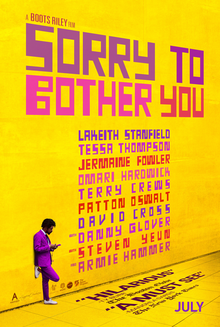
Sorry to Bother You

Sorry to Bother You (2018)
Starring Lakeith Stanfield, Tessa Thompson, Jermaine Fowler, Omari Hardwick, Terry Crews, Danny Glover, Steven Yeun, and Armie Hammer
And the Vocal Talents of David Cross, Lily James, and Patton Oswalt
Directed by Boots Reilly
Written by Boots Reilly


The RyMickey Rating: B

Sunday, January 26, 2020

Lady and the Tramp

Lady and the Tramp (2019)
Starring Thomas Mann, Kiersey Clemons, Yvette Nicole Brown, Adrian Martinez, and F. Murray Abraham
and Featuring the vocal talents of Tessa Thompson, Justin Theroux, Sam Elliott, Ashley Jensen, Benedict Wong, Clancy Brown, and Janelle Monáe
Directed by Charlie Bean
Written by Andrew Bujalski and Kari Granlund

Click here for my Letterboxd review

The RyMickey Rating: C+

Tuesday, February 12, 2019

Annihilation

Annihilation (2018)
Starring Natalie Portman, Jennifer Jason Leigh, Gina Rodriguez, Tessa Thompson, Tuva Novotny, and Oscar Isaac
Directed by Alex Garland
Written by Alex Garland
***This film is currently streaming via Amazon Prime***


Click here for my Letterboxd review

The RyMickey Rating:  B-

Saturday, December 08, 2018

Creed II

Creed II (2018)
Starring Michael B. Jordan, Sylvester Stallone, Tessa Thompson, Phylicia Rashad, Florian Munteanu, and Dolph Lundgren
Directed by Steven Caple, Jr.
Written by Juel Taylor and Sylvester Stallone

Summary (in 500 words or less): Adonis Creed (Michael B. Jordan) is approached by a wrestling promoter to take on a bout against Viktor Drago (Florian Munteanu), son of Ivan Drago (Dolph Lundgren) who defeated and killed Creed's father in the ring decades ago.


The RyMickey Rating: C

Friday, March 30, 2018

Thor: Ragnarok

Thor: Ragnarok (2017)
Starring Chris Hemsworth, Tom Hiddleston, Cate Blanchett, Idris Elba, Jeff Goldblum, Tessa Thompson, Karl Urban, Anthony Hopkins, and Mark Ruffalo
Directed by Taika Waititi
Written by Eric Pearson, Craig Kyle, and Christopher Yost

Summary (in 500 words or less):  Thor (Chris Hemsworth) returns to his home planet of Asgard and forces his brother Loki (Tom Hiddleston) to help find their father Odin (Anthony Hopkins) who was missing, but then found hiding in Norway.  Odin reveals that he is dying and that his death will unlock the prison cell that his firstborn daughter Hela (Cate Blanchett) has been kept in for years because of Odin's fear that his daughter was becoming too ambitious.  Upon Odin's death, Hela returns to Asgard and chaos begins to reign as she forces Thor and Loki off the planet.  Thor lands on  Sakaar, a weird planet full of space waste and home to massive gladiator-style battles by people captured by The Grandmaster (Jeff Goldblum), one of whom happens to be the Hulk (Mark Ruffalo) who had been missing ever since the events of "Captain America: Civil War."

  • Right off the bat, I should just say that Thor: Ragnarok is my favorite Marvel movie yet.  Director Taika Waititi (along with the trio of screenwriters) have crafted a fun-filled humorous ride filled with solid action sequences that carry some gravitas and importance in the grand scheme of the Thor franchise storyline.
  • The balance struck here by Waititi in terms of action and humor is what the Guardians movies wants to be, but hasn't yet achieved. 
  • Considering how much I despised Thor: The Dark World, I admittedly wasn't expecting much here, but the change in tone to something a bit more light-hearted works amazing well.
  • Despite the oftentimes more whimsical and humorous nature of the film, there's still some important stuff going on here.  The family dynamic between Thor, his sister Hela, and their brother Loki is some heavy stuff and carries heft in the grand scheme of Thor's story...all the while likely helping to set up storylines for the upcoming Avengers film.
  • Kudos to the entire cast -- Chris Hemsworth gets to display his comedic chops (which are always impressive), Jeff Goldblum and Mark Ruffalo appear to be having a ton of fun, Tessa Thompson brings a strong female presence to the proceedings, and Cate Blanchett tears up the screen as the villainess.  SPOILER ALERT -- Here's hoping they can find some way to bring her back in future films because she lit up the screen whenever she appeared.
The RyMickey Rating:  B+

Sunday, January 31, 2016

Movie Review - Creed

***Rocky Week -- Day 7***
***Note:  Spoilers may appear in all Rocky Week reviews.***
Creed (2015)
Starring Michael B. Jordan, Sylvester Stallone, Tessa Thompson, Tony Bellew, and Phylicia Rashad
Directed by Ryan Coogler

Without any shred of doubt, Creed is the best made film in the Rocky franchise.  Does that make it the best film overall?  Not quite, but it's definitely up there in terms of quality, acting, story, and direction.  While staying true to its roots with simple homages to the past, Creed introduces us to a new lead character to whom we in the audience admittedly don't quite have as much connection which hampers things a little bit.  Fortunately, though, Creed doesn't abandon all that made Rocky so successful, giving us a touching performance from our former title character in what may be the best role of Sylvester Stallone's career.

As a young boy, Adonis Johnson lived his life moving from foster home to foster home and eventually landed himself in a juvenile detention facility.  At the age of 13, Adonis is visited by Mary Anne Creed (Phylicia Rashad) who takes the young boy in and tells him of his true lineage -- that he is the result of a extramarital affair between her husband (the late Apollo Creed) and Adonis's mother.  Seventeen years pass and despite Mary Anne's wishes that he hold down a good job, Adonis (played as an adult by Michael B. Jordan) feels a passion for boxing and travels to Philadelphia to train with the man who helped to shape Apollo into the name that he was -- Rocky Balboa.

Rocky himself is a bit more weathered, a bit more weary of jumping back into the boxing world.  His pace of everything -- the way he talks, the way he walks -- has slowed as time and his boxing past has taken its toll on him.  Stallone plays Rocky vulnerable here -- and while we maybe saw tinges of that in Rocky Balboa, this adds huge layers of depth to a character we've long known.  Smartly (and perhaps this is due to the fact that this is the first Rocky film to not be written by Stallone), Rocky doesn't steal the spotlight.  Director Ryan Coogler has made this Adonis Creed's film, but Rocky and Stallone's portrayal are the reason the film succeeds as well as it does.

There's a visceral, in-your-face style that director Ryan Coogler and cinematographer Maryse Alberti bring to the table that we haven't seen in previous Rocky flicks.  Moreso than ever, we feel a part of the action -- we're in the ring fighting with or against Adonis, close enough to feel his pain and comprehend the pain he inflicts.  One scene in particular showcases Adonis's first "real" fight and it's completed in one take that is so blissfully choreographed and amazingly shot that I found myself awestruck.  But Coogler also allows for quieter moments to shine, particularly in some rather touching scenes between Michael B. Jordan and his love interest Bianca played by Tessa Thompson.  Jordan carries many of the same characteristics as Stallone in the first Rocky film, but there's a bit more of an innocence within the tough exterior -- an innocence that probably stems from a sense of hope and heartbreak (both stemming from his difficult, fatherless childhood) that Rocky himself never really experienced.  Thompson also does a nice job of bringing out the softer side of Adonis, obviously playing the "new Adrian," but she's certainly a captivating presence.

As mentioned, there is no doubt that Creed is the best made film in the Rocky franchise.  However, were I to choose to watch another Rocky flick, I'd go with Rocky Balboa first, followed by the original, and then give Creed another go (despite giving Creed a higher grade than the original Rocky).  In time, with inevitable subsequent Creed releases, I'll get to know Adonis a little better as a character and my opinion of this movie will likely only increase in its positivity.  As it stands now though, Creed succeeds for not only introducing us to a new title character, but giving tribute to the iconic Rocky.

The RyMickey Rating:  B+
Sunday, August 30, 2015

Movie Review - Dear White People

Dear White People (2014)
Starring Tessa Thompson, Tyler James Williams, Brandon P Bell, Teyonah Parris, Kyle Gallner, and Dennis Haysbert
Directed by Justin Simien

While not quite as laugh-out-loud funny as I had thought it would be, Dear White People is a film that doesn't shy away from some uncomfortable racial humor in order to detail race relations on college campuses.  Set at the fictional Ivy League Winchester University, screenwriter-director Justin Simien's debut film shows that the sometimes "on edge" feeling between whites and blacks isn't the fault of either culture, but rather due to the fact that post-racial America has created a society where political correctness actually makes it much more difficult to unite as both sides feel they are being talked down to or coined racist for expressing an opinion that simply may not toe the "correct" line.

The film opens with a news report stating that a group of white students held a "black face" party on Halloween setting the campus community into an uproar and starting a small riot.  We then flashback a few weeks to see the lead-up to this event, focusing mainly on the black student population as headstrong radio DJ Sam (Tessa Thompson) whose radio show skewers the white student body of Winchester goes up against seemingly by-the-books Troy (Brandon Bell) whose father (Dennis Haysbert) is the Dean of Students to be the head of the traditionally black Armstrong/Parker House.

This battle is the basis of all conflicts in Dear White People as Simien explores not only white-black race relations, but also rifts within the African American culture itself.  (Note:  In a rather funny line, the film states that utilizing the term "African American" is inherently racist itself in that white culture uses the words because they're "afraid" to simply use the term black thanks to current societal norms.)  Unfortunately, Simien's film seems a little disjointed and it feels a bit obvious while watching that we're witnessing a debut film.

While the direction may have felt a little sitcom-ish at times, the cast more than makes up for the flick's faults.  The aforementioned Tessa Thompson is a compelling lead and Tyler James Williams as a newspaper reporter covering the racial issues on campus is also humorously enjoyable.  Teyonah Parris also succeeds in a rather difficult role as Coco, a stuck-up black student who feels more motivated by white culture than her own.

Rather interestingly, Coco's story is really at the heart of what Dear White People is trying to espouse.  While there's importance in understanding one's own culture, is there really anything wrong with finding an appeal in another way of life?  Perhaps there is, or maybe there isn't.  Your interpretation of what the film has to say may vary, but Simien does a good job at skewering all sides of the argument.  In the hands of a slightly more capable director, Dear White People would've really shined, but as it stands now, it's still an interesting film that's worth a watch and a nice start for a new voice on the film landscape.

The RyMickey Rating:  B-

Friday, February 06, 2015

Movie Review - Selma

Selma (2014)
Starring David Oyelowo, Carmen Ejogo, Tom Wilkinson, Tim Roth, Common, Renee Toussaint, Wendell Pierce, André Holland, Ruben Santiago-Hudson, Colman Domingo, Omar J. Dorsey, Tessa Thompson, Giovanni Ribisi, Jeremy Strong, Henry G. Sanders, Keith Stanfield, Oprah Winfrey, Cuba Gooding, Jr., and Martin Sheen
Directed by Ava DuVernay

For years, I've made note of how much I hate the film genre of the "biopic," but over the past few years, I've grown to appreciate what such flicks bring to the table in terms of opening my eyes to the intricacies of historical events that may have not necessarily flown under my radar, but perhaps been lower key in my mind than they probably should have been.  In 2014 alone, I've been treated to two very good stand-outs in the genre with The Imitation Game and The Theory of Everything.  Selma joins that list.

Smartly detailing only a small segment of his life, Selma focuses on Martin Luther King, Jr.'s attempted 1965 fifty-four mile march from Selma to Montgomery, Alabama, in order to raise awareness of that state government's refusal to give black Americans the right to vote.  Rather than introduce us to Mr. King via childhood anecdotes or college shenanigans, director Ava DuVernay and screenwriter Paul Webb sink us right into the action with King (played strongly and confidently by David Oyelowo) trying to persuade President Lyndon Johnson (Tom Wilkinson) to pass a Voter's Rights Act that would allow all Americans to be allowed to register to vote without harassment from government officials.  When Johnson denies that request, King decides that he must continue on his mission of peaceful, nonviolent protest in order to get his point to the American people since his government was not assisting in providing this basic human right.

The film very shrewdly shows that King was cunningly media-savvy, knowing that in order for him to succeed, he needed to have cameras and reporters present.  While he respected the work that some lesser black community organizations were doing to push voting bills into place, King knew that they would fail simply because they were "too small."  This sly intelligence and insight into this brilliant man's mind was interesting to see unfold.  Credit must also be given to the fact that the film doesn't present King as a saint as his well-known infidelities are touched upon more than once.

David Oyelowo takes on the unenviable task of embodying Mr. King -- a man whose recorded and televised speeches are some of the most well-known in American history.  Oyelowo is hugely successful at bringing the civil rights' leader's diction, mannerisms, strength, humility, and intelligence to the screen.  Oyelowo is moving in the film's quiet moments, yet powerfully rousing as the rather ingenious orator that King was.  Oyelowo is buoyed by a strong supporting cast that weave in and out of the tale, including a nice turn from Carmen Ejogo as King's put-upon wife Coretta.  Tom Wilkinson as a headstrong (less-than-eloquent) president provides a nice counterpoint to King's/Oyelowo's passionate fervor.  (Also interesting to note -- Democrats weren't exactly kosher with the African American community getting the right to vote -- yet us Republicans are constantly paraded around as the more "racist" party.)  Particularly moving is an incredibly strong small role by Henry G. Sanders as the grandfather of a young man killed in cold blood by an Alabama police officer.  Sanders has very few scenes, but I found him riveting and emotionally powerful whenever he was onscreen.

On the downside, the film felt a little longer than its two hour running time and I found myself checking the watch a few times.  However, I certainly was never bored.  Perhaps more than any other film I've seen this year, I came away from the theater thinking about how our society needs someone powerful like Martin Luther King, Jr., today.  The Al Sharptons and Jesse Jacksons of the world are only out for themselves despite what they may have you believe.  While I mentioned King's utilization of the media above, Sharpton and Jackson manipulate the media for their own time in the spotlight.  King used the press for the betterment of the people.  

The film certainly comes along at a pivotal time in our culture what with the Ferguson fiasco.  No matter where your opinion may fall on that spectrum, what this film showed me was that our society now doesn't have the voice that Martin Luther King, Jr., provided in the 1960s.  (I always thought Bill Cosby could maybe have been that voice -- but we all know where that ended up now.)  In that way, Selma made me quite sad for our current state of affairs.  King didn't pit society in a black-against-white type way, whereas nowadays that's the way everything is presented whenever "race" is involved.  King knew that a "race war" wouldn't solve any problems -- unity was needed, not race baiting.

Kudos to the relatively new-to-the-scene Ava DuVernay who has crafted a pic that resonates.  She doesn't necessarily pull out any tricks (and when she does, they sometimes fall flat -- like a slow-motion fight scene involving police officers and actress Oprah Winfrey), but she creates a impact showcasing the courage of not only Dr. King, but the many black and white Americans who quite literally joined hands with him to create change.  There's power in these images DuVernay brings to the screen -- the opening shot of the Sixteenth Street Baptist Church Bombing starts things off with such an impact that I was taken aback (in a good way) by the way Ms. Duvernay decides to present things -- and there's absolutely something to be said for being able to create something that can carry such weight.

The RyMickey Rating:  B+